
Commercial Kitchen Plumbing Compliance in Birmingham
A commercial kitchen in Birmingham carries plumbing compliance requirements a typical restaurant owner doesn't think about until an inspection or a backup forces the issue.
By the Birmingham Apex Plumbing team.
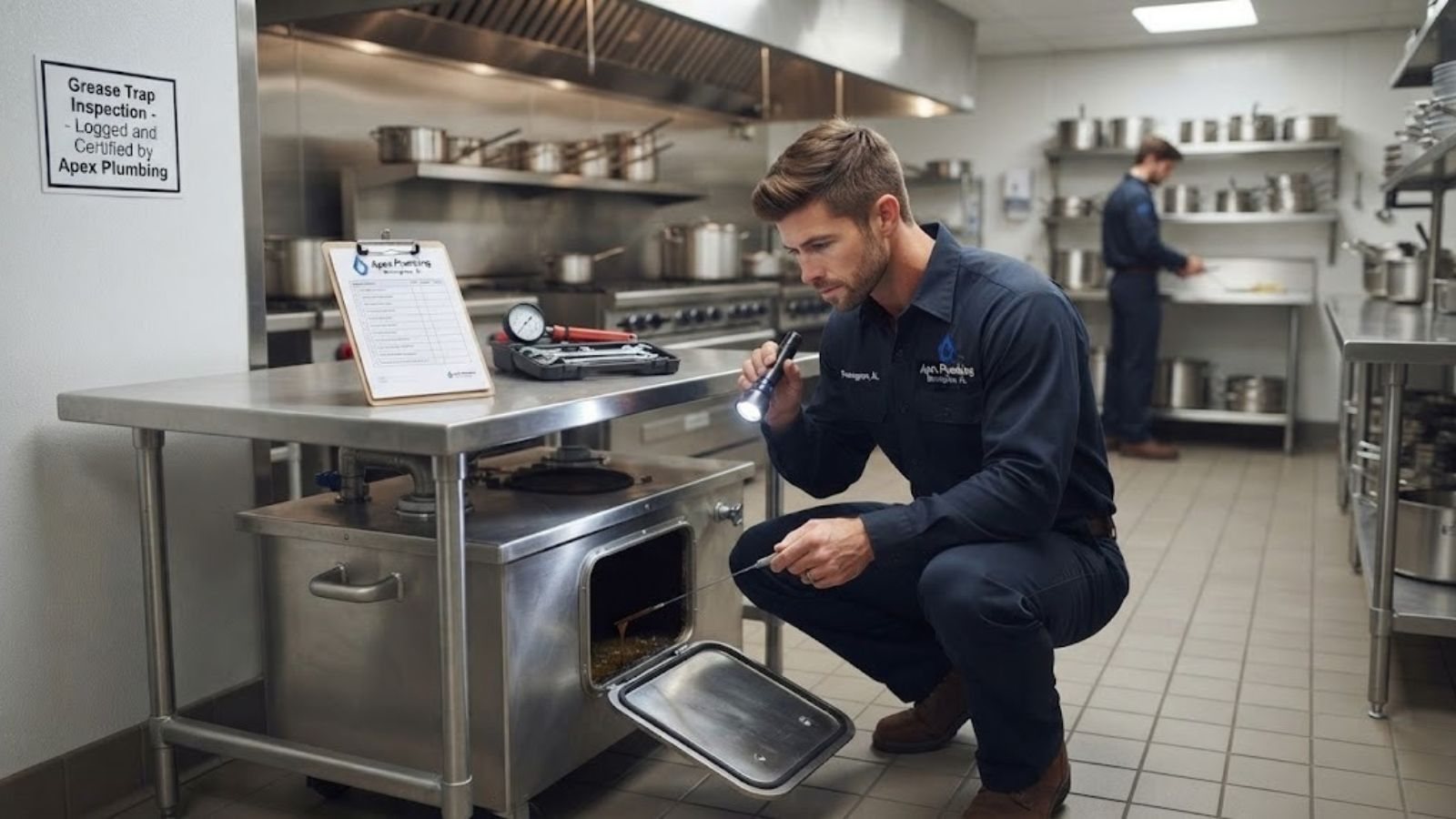
Running a commercial kitchen means more than passing a health inspection on food handling. Grease discharge limits and backflow prevention are both enforced separately, with their own compliance requirements and their own consequences for skipping them. Neither is complicated once it's on a regular schedule, but both cause real problems when they're treated as an afterthought.
What Jefferson County actually enforces
Jefferson County Environmental Services enforces grease discharge limits on commercial kitchens, and an overdue or overflowing grease trap is both a functional plumbing problem and a compliance risk. Most commercial kitchens need grease trap pumping and cleaning every few weeks to a few months, not annually, and the right interval depends on actual kitchen volume rather than a generic default. A service record showing the pumping date and volume removed is typically what a health inspector wants to see as proof of a maintained schedule.
Why this applies to most commercial kitchens
A commercial kitchen connection typically requires an annual backflow preventer test, since the device stops contaminated water from being pulled back into the clean supply if pressure drops unexpectedly. Backflow testing is a short annual visit for a device already installed, but a failed test means repair or replacement before certification is issued, so it's worth scheduling with enough lead time before a renewal deadline rather than the day compliance is actually due.
Beyond the two big items
A health or plumbing inspection of a commercial kitchen typically checks for a properly functioning grease interceptor, current backflow certification, adequate floor drainage, and no cross-connections between potable and non-potable water sources. Missing any single item can delay an inspection or a permit renewal, which is disruptive for a business that depends on staying open. Keeping documentation for both grease trap service and backflow testing in one place makes producing it during an inspection straightforward rather than a scramble.
Building compliance in from day one
A new restaurant buildout or a significant kitchen remodel is the point where grease trap sizing and backflow device placement should be confirmed against current code. That's better than inheriting whatever the previous tenant had installed. An undersized grease trap installed to save money upfront usually costs more over time in increased service frequency and repeat compliance issues than sizing it correctly from the start would have.
Owner vs. tenant, clarified
A lease often assigns day-to-day grease trap maintenance to the tenant operating the kitchen, while the building owner remains responsible for the underlying plumbing infrastructure itself. That split can get confusing when a compliance issue arises, especially in a shared commercial building with multiple tenants on one system. Clarifying this in writing before an issue comes up, rather than during an active inspection failure, avoids a dispute over who's actually supposed to call for service.
A shared system complicates things
A strip mall or shared commercial building with several food service tenants on one grease interceptor faces a coordination challenge beyond a standalone restaurant's simpler situation. One tenant's excessive grease discharge can affect the shared system's performance for everyone connected to it, which is part of why some multi-tenant buildings move to individual, per-unit interceptors rather than relying on a single shared system that's harder to manage fairly.
Why this comes up in commercial corridors
Hoover's commercial areas around the Riverchase Galleria and surrounding retail corridors include a significant concentration of restaurants and food service businesses. That's exactly the kind of commercial density where grease trap and backflow compliance questions come up regularly, whether for a new location or an existing one catching up on deferred maintenance.
Why a failed inspection is expensive beyond the fine
A failed health or plumbing inspection tied to grease trap or backflow noncompliance rarely stops at just a fine. A business may face a follow-up inspection deadline, temporary operating restrictions in serious cases, and the reputational cost of a visible citation, on top of the actual cost of the compliance fix itself. Preventing that situation with a simple maintenance schedule costs far less than reacting to it after an inspector has already flagged the problem in front of staff and, sometimes, customers.
Making compliance routine rather than reactive
A scheduled maintenance contract for grease trap service, set at an interval matched to actual kitchen volume rather than guessed at, removes the need to remember or track it manually. Pairing that with an annual backflow test reminder, ideally scheduled a month or two before the actual renewal deadline, builds a simple compliance calendar that a busy kitchen manager doesn't have to think about beyond confirming the scheduled visit happened. That kind of routine beats reactive compliance every time an inspector actually shows up unannounced.
Most kitchens that fail an inspection weren't neglecting compliance on purpose. They simply never set up a schedule in the first place, and drifted until something forced the issue.
What trips up otherwise careful operators
Assuming a previous tenant's grease trap and backflow setup already meets current code is a frequent mistake, since requirements change over time and older equipment doesn't automatically get upgraded when ownership changes. Another common misstep is scheduling backflow testing right at the renewal deadline rather than with a buffer, which leaves no time to fix a failed test before the deadline actually passes. Both mistakes are avoidable with a small amount of planning built into the kitchen's normal operating routine, not extra effort on top of it, once it's actually set up correctly the first time and kept that way going forward.
- Keep grease trap service records showing dates and volume removed.
- Keep current backflow test certification on file and visible if requested.
- Note your grease trap's rated capacity versus actual kitchen volume.
- Confirm backflow device location and accessibility before a scheduled test.
Common questions
How often does a commercial kitchen actually need grease trap service?
It depends on kitchen volume, but most need service every few weeks to a few months rather than annually. A technician can help establish the right interval based on actual usage.
What happens if a backflow test fails during a renewal?
The device is repaired or replaced and then retested before certification is reissued. Scheduling the test with lead time before a deadline avoids a compliance gap if repair is needed.
Can one company handle both grease trap service and backflow testing?
Often yes, and coordinating both on a similar schedule simplifies recordkeeping for an inspection compared to tracking two completely separate vendor relationships.
Serving greater Birmingham, AL
Have a plumbing question of your own?
Call and describe what you're seeing - a real technician can usually tell you what's going on before ever stepping through the door.
Call (855) 575-2890