
Service Area: Birmingham, AL & the Jefferson County Metro
Dispatch covers Birmingham itself along with the towns and neighborhoods below. Hoover, Vestavia Hills, Homewood, Trussville, and Bessemer have their own dedicated pages; call (855) 575-2890 to confirm coverage for any other address in the meantime.
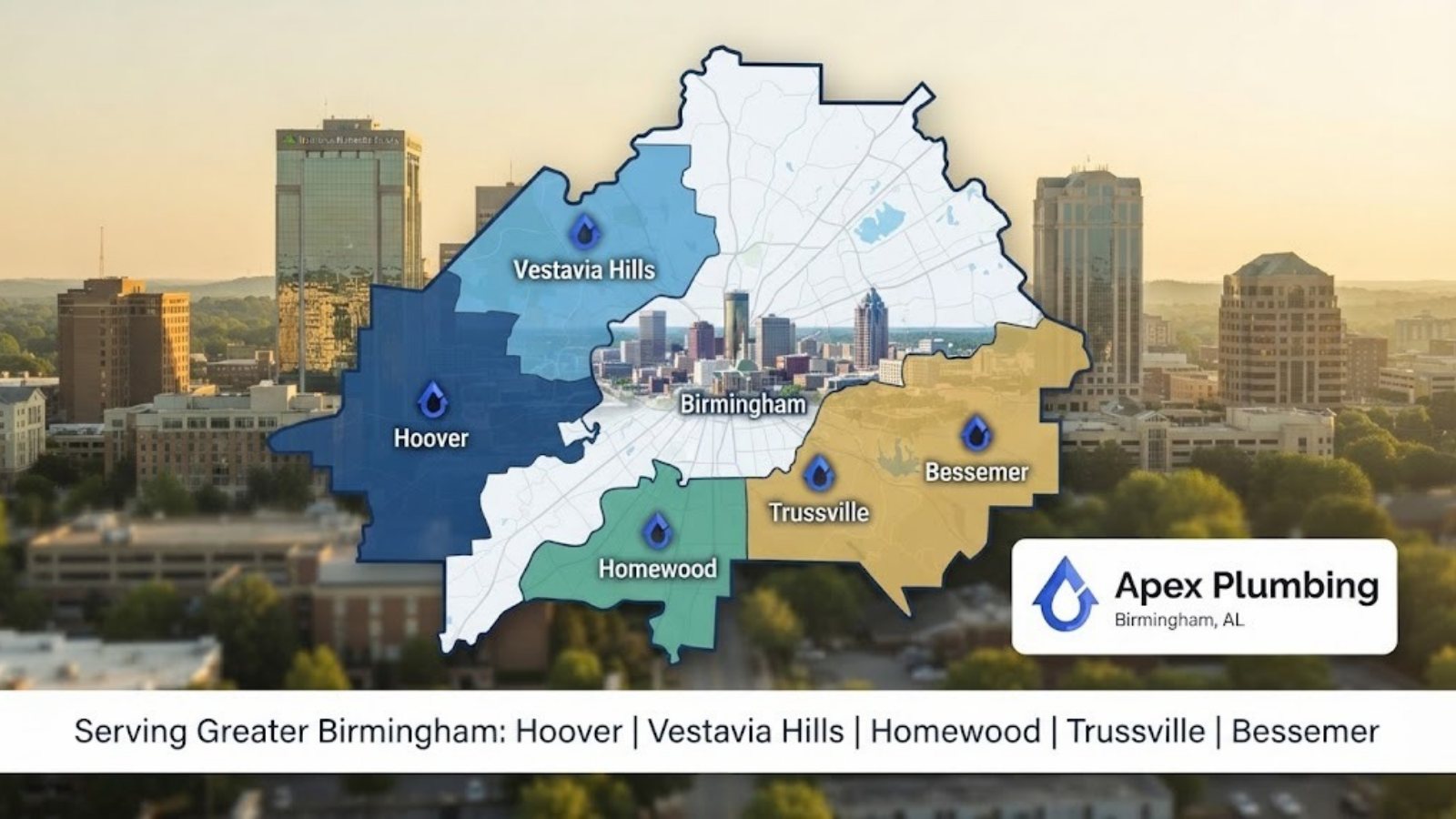
Every town listed above gets regular dispatch coverage.
Older core, newer suburbs
Closer-in areas like Homewood and Mountain Brook share Birmingham's older housing stock. That means the galvanized or cast iron supply and drain lines that come with it, while newer development toward Hoover, Pelham, Alabaster, and Helena runs mostly PVC and PEX. Both eras deal with the same hard water from the Birmingham Water Works Board, so water heater scale buildup shows up across the whole metro regardless of when a specific neighborhood was built.
Trussville, Gardendale, Irondale, and Leeds sit further out along Birmingham's main commuter corridors, and Bessemer covers the western side of the metro. Dispatch confirms drive time to any of these on the call itself rather than making you guess from a coverage map. Call (855) 575-2890 to confirm your address.
What's different about each area
Hoover is the largest suburban city in Alabama, spanning parts of both Jefferson and Shelby counties. Its mix of decades-old subdivisions and newer construction near the Riverchase Galleria area means plumbing age varies block to block more than almost anywhere else on this list, so a technician confirms pipe material on-site rather than assuming from the neighborhood alone.
Vestavia Hills and Mountain Brook sit along Red Mountain and are among the metro's older, established Over-the-Mountain suburbs, with housing stock that commonly still runs original supply and drain lines from the mid-20th century. Homewood, just south of Red Mountain, shares a similar age profile in a smaller, denser footprint.
Pelham, Alabaster, and Helena represent Birmingham's newer growth corridor south along the Shelby County line, largely PVC and PEX construction with fewer corrosion-driven emergency calls but the same hard-water scale issue in water heaters. Bessemer, on the metro's western side, has its own older industrial-era housing stock with plumbing needs closer to Birmingham's urban core than to the newer southern suburbs.
Jefferson and Shelby County dispatch
Because Hoover, Pelham, Alabaster, and Helena sit partly or fully in Shelby County rather than Jefferson County, dispatch already routes across both without treating the county line as a coverage boundary. Permit and code requirements are confirmed against whichever county the actual job site sits in, since Jefferson County's contractor registration rules don't automatically carry over to Shelby County work.
Trussville also straddles the Jefferson-St. Clair county line further east, and Leeds spans three counties at once (Jefferson, St. Clair, and Shelby). The same approach applies to both: coverage follows the address, not the map boundary that happens to run near it.
What to expect on drive time
Birmingham proper and the closest-in suburbs (Homewood, Irondale, Mountain Brook) get the fastest turnaround on emergency calls simply because of proximity to where technicians are typically already working. Outer towns - Trussville, Leeds, Bessemer, Alabaster, Helena - still get full 24/7 emergency coverage, but the dispatcher gives an honest drive-time estimate on the call rather than promising the same window regardless of distance.
Non-emergency scheduling works the same across every town on this list: an appointment window confirmed at booking, with a call ahead when the technician is on the way.
If an address falls right at the edge of one of these coverage zones, the safest move is still to call rather than assume either way. Confirming coverage takes a few seconds on the phone and avoids a wasted trip in either direction.
This list will keep growing as the site's remaining location pages go live, each with more detail specific to that town - real landmarks, local housing patterns, and the ZIP codes that town actually covers. Until then, the town names and general coverage notes above are accurate; the deeper per-town detail is simply not built out yet.
In practice, that means a call today gets the same accurate answer about coverage and drive time that a future dedicated town page would give - it just arrives by phone instead of by reading a page. Nothing about coverage itself is contingent on those pages existing yet, and that will remain true as more of them go live over the coming weeks.
The quickest path to a real answer, for now, is still the phone rather than waiting on the page itself. That answer takes less time than reading this whole paragraph did just now, honestly.