
Garbage Disposal Troubleshooting: Fix It or Call a Plumber?
A garbage disposal problem usually falls into one of two categories. One is safe to try fixing yourself. The other genuinely isn't.
By the Birmingham Apex Plumbing team.
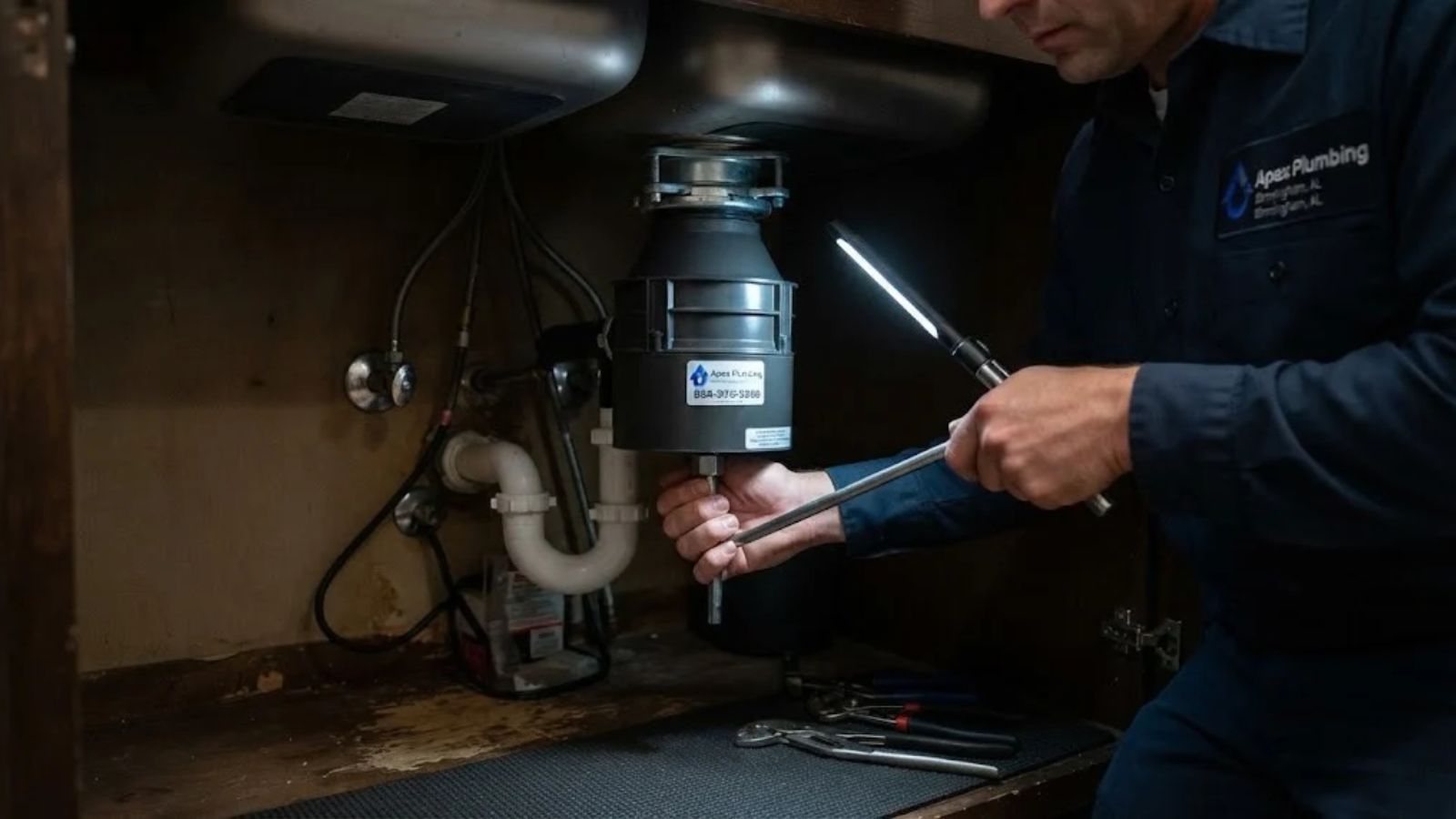
A garbage disposal is one of the few kitchen appliances most homeowners feel comfortable troubleshooting themselves, and for good reason. Several common problems have a genuinely safe, simple fix. A few others carry real risk or point to a bigger issue, and knowing which category a specific symptom falls into saves both a wasted service call and, in the risky cases, a genuine injury.
Humming without spinning
A disposal that hums but doesn't spin almost always has something jammed against the impellers. With power off at the switch, the offset wrench that came with the unit (or a hex key) fits into the bottom center hole to manually free the impellers. Once freed, the reset button on the bottom of the unit, and then the wall switch, should bring it back to normal operation. This is genuinely one of the safest and most common disposal fixes a homeowner can handle without calling anyone.
Persistent odor
An occasional bad smell usually clears with a simple treatment: grinding a few ice cubes with a bit of citrus peel scrubs the impeller chamber mechanically without any chemicals. This is a low-risk, low-effort fix worth trying before assuming something more serious is wrong, especially if the disposal is otherwise working normally and the smell is the only complaint.
Leaking from the bottom
A disposal leaking from underneath the unit itself, rather than at a fitting or connection, means the internal seal has failed. That seal isn't a separately replaceable part on most residential units, which makes this a replacement situation rather than a repair. Continuing to run a disposal that's leaking internally risks water damage to the cabinet below, so this is worth addressing promptly rather than waiting to see if it gets worse.
Tripping the circuit breaker
A disposal that trips the home's circuit breaker, rather than just its own internal reset button, usually means the motor is failing and drawing excessive current. This isn't a jam to clear; it's a sign the unit itself needs professional diagnosis, and continuing to reset the breaker repeatedly risks an electrical problem beyond just the disposal.
When the drain, not the disposal, is the issue
A disposal that runs fine but the sink still backs up points to the branch drain line rather than the disposal itself. Drain cleaning addresses that separately, and it's worth distinguishing the two before assuming a working disposal means there's no plumbing problem at all.
Habits that actually reduce problems
Running cold water for a short time before and after grinding helps solidify grease so it flushes through rather than coating the impeller chamber over time. Avoiding fibrous scraps like celery and corn husks, along with hard items like bones and fruit pits, reduces jam frequency significantly compared to treating the disposal as a catch-all for any food waste. These small habits cost nothing and meaningfully extend the time between problems worth calling about in the first place.
What actually matters when it's time
A replacement disposal is rated by horsepower, and a household that runs a lot of food waste through the sink benefits from a higher-horsepower unit than whatever builder-grade minimum came with the original home. Noise insulation has also improved meaningfully in newer units compared to older models, which matters more in an open-concept kitchen where the sink sits close to living space. A technician can size the right replacement to actual household cooking habits rather than defaulting to whatever's cheapest on the shelf.
Rare, but worth knowing
A disposal problem is almost never a true plumbing emergency on its own, since a sink can simply go unused until service is available without causing water damage or a health hazard. The one exception is a disposal leaking steadily enough to threaten cabinet or subfloor damage, which is worth addressing promptly rather than waiting for a routine appointment slot, even though it doesn't require the same urgency as active flooding elsewhere in the home.
Everything else covered here can reasonably wait for a normally scheduled visit rather than an emergency dispatch.
A different kind of clue
A single household almost never has more than one disposal, so this scenario applies mainly to a rental property or commercial setting managing several units. Multiple disposals failing around the same time, especially with the same symptom, often points to a shared cause - consistently hard water across the property, or a batch of original units all reaching the end of their working life together - rather than coincidence. Addressing the shared cause is more efficient than treating each failure as an unrelated, isolated incident.
A property manager noticing this pattern across several units should mention it specifically when scheduling service.
Worth checking before paying for repair
A relatively new disposal, especially one installed within the last few years, may still be under manufacturer warranty for parts or even the full unit, depending on the brand and model. A self-repair attempt sometimes voids that warranty coverage, which is worth checking before opening up a unit that might otherwise qualify for a free replacement. Keeping the original receipt or registering the warranty at installation makes this a much easier question to answer later.
Why disposal age matters here too
Homes in Trussville built during the growth surge of the 1980s and 1990s often still have original disposals reaching the end of a typical unit's working life. A disposal original to a home built decades ago is worth considering for replacement even while still technically functioning, since older units run at lower horsepower and with less noise insulation than what's commonly available now.
- Turn off power at the switch before attempting to clear any jam.
- Never put your hand inside the disposal, even with power off.
- Note whether the issue is no power, humming, leaking, or tripping the breaker.
Common questions
Is it safe to use a flashlight to look inside a jammed disposal?
Looking is fine with the power off, but never reach inside with your hand, even briefly. Use the offset wrench or tongs to clear anything visible.
How long should a garbage disposal last before needing replacement?
Most residential units last around 8 to 12 years with normal use, though heavy use and hard water buildup can shorten that.
Can I install a new garbage disposal myself?
It's a moderately involved electrical and plumbing task. A professional install ensures correct sizing, a proper dishwasher connection if applicable, and code-compliant wiring.
Serving greater Birmingham, AL
Have a plumbing question of your own?
Call and describe what you're seeing - a real technician can usually tell you what's going on before ever stepping through the door.
Call (855) 575-2890