
What Jefferson County's Sewer System Means for Your Home
Most Birmingham-area homes connect to Jefferson County's sewer system. Few homeowners know where the county's responsibility ends and their own actually begins.
By the Birmingham Apex Plumbing team.
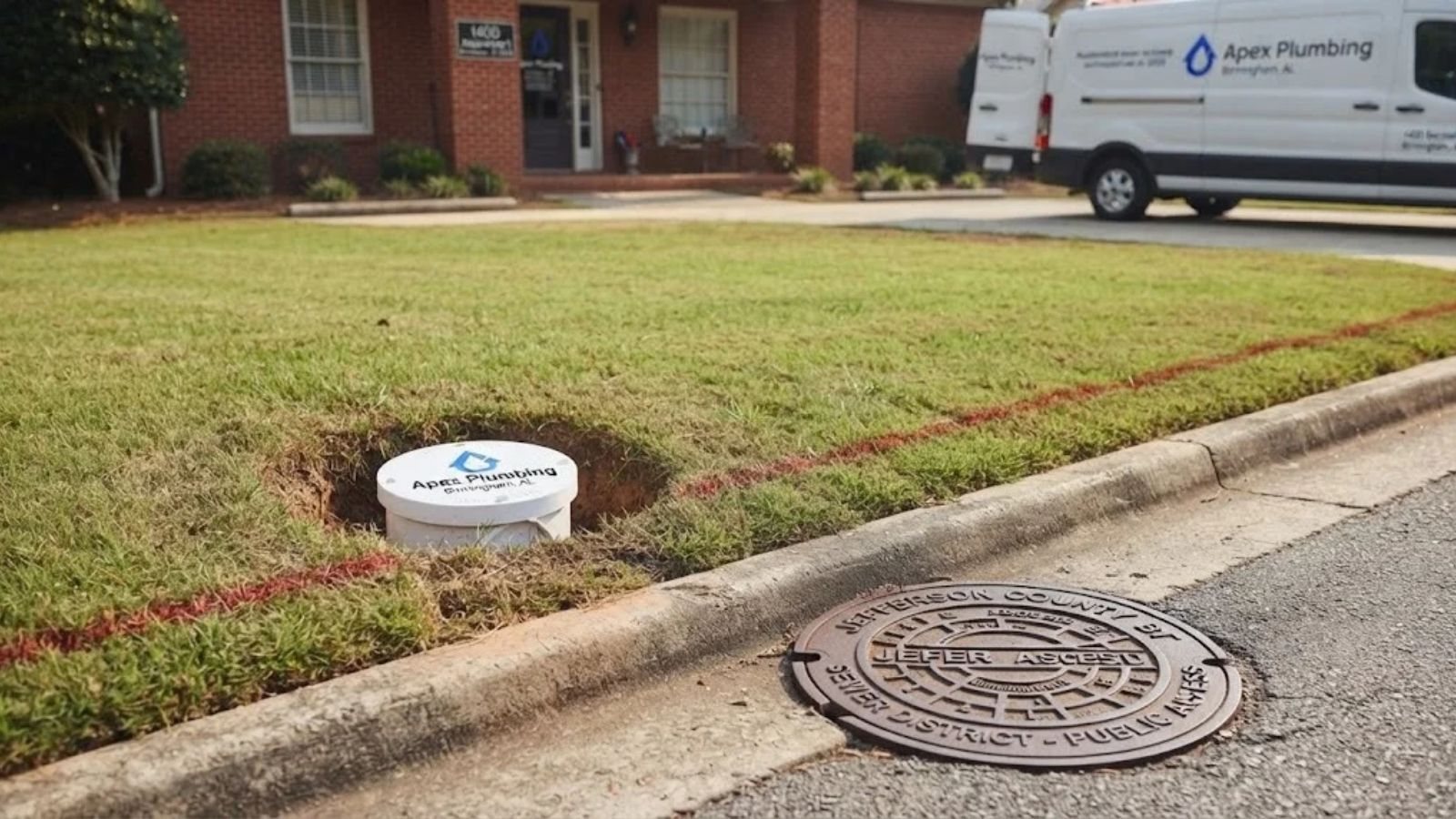
Jefferson County Environmental Services operates more than 3,100 miles of sewer line across the metro, one of the larger wastewater systems in the state. That system has been under a consent decree tied to past overflow and infrastructure issues, with major elements of that decree released in 2024 following years of required upgrades. For an individual homeowner, the practical question is simpler: which section of pipe is the county's problem, and which is yours.
The lateral is the homeowner's responsibility
The county owns and maintains the main sewer lines running under streets and easements. The homeowner owns the sewer lateral - the pipe connecting the house to that main line - typically from the home's foundation all the way to the connection point at the street. A backup or failure in that lateral section is the homeowner's repair, not the county's, even though it might feel like a public infrastructure problem when it happens. This is exactly the section covered by sewer line repair on this site.
A backup doesn't mean it's the county's fault
A sewage backup into a home is alarming, and it's a natural instinct to assume the public system is at fault. In practice, the far more common cause is a private lateral problem - root intrusion, a bellied section, or simple grease and debris buildup in the homeowner's own pipe. A sewer camera inspection identifies exactly where a blockage or damage sits, which also clarifies whose responsibility the repair actually is before any work starts.
What decades-old sewer connections mean today
Homes in Birmingham's older neighborhoods commonly have original cast iron or clay sewer laterals, some now many decades old. These materials are far more prone to root intrusion at pipe joints and interior scale buildup than the PVC used in current installations. A lateral that's needed repeated clearing for the same recurring clog is a common sign of something deeper. The pipe itself, not just the specific blockage, has likely reached the point where trenchless pipe lining or a traditional excavation repair makes more sense than continuing to clear it repeatedly.
A dense, older sewer network
Homes in Homewood, largely built out between the 1920s and 1950s, sit on some of the oldest lateral connections in this coverage area. The city's dense, fully built-out layout also means tree roots from decades-old, established landscaping sit close to many of these lines, which is part of why root intrusion comes up so consistently as a cause of recurring backups here specifically.
What to do first
A problem affecting multiple homes on the same street at once, rather than just one house, is a stronger signal. It usually means the issue sits in the county's main line rather than a private lateral. Jefferson County Environmental Services takes reports on public system issues directly, and that's the right first call for a suspected main-line problem rather than a private plumber, since a private technician can't repair public infrastructure regardless of how the call is routed.
What years of upgrades changed
The consent decree covering Jefferson County's system required substantial investment in reducing sanitary sewer overflows. Those are events where excess flow, often from heavy rain entering aging pipe, exceeds system capacity and discharges before reaching treatment. Years of infrastructure work went into reducing how often that happens across the county's public system. None of that public-side work addresses a private lateral's own age or condition, which is exactly why a homeowner with an aging lateral can still see recurring problems even as the county's own system improves around it.
What changes when a home is renovated
Adding a bathroom, finishing a basement, or otherwise increasing a home's fixture count typically requires a permit that accounts for whether the existing lateral can handle the added load. Skipping that step on an older lateral already near capacity is a common way a renovation ends up causing a sewer backup that wasn't a problem before the work started, even though the lateral itself didn't change. Confirming lateral capacity before a major renovation avoids that surprise entirely.
Why landscaping matters for old laterals
A mature tree planted decades before a home's lateral started showing problems can still be the eventual cause. Roots grow steadily toward any source of moisture and nutrients, including a leaking pipe joint underground. Removing an established, healthy tree solely to protect a sewer line is a significant decision with its own tradeoffs, and it isn't always the first or best answer. Root-cutting equipment paired with sealing the specific damaged joint often addresses the immediate problem without requiring that larger, separate decision.
What this means day to day
Most Birmingham-area homeowners will never need to think much about the difference between public and private sewer infrastructure until the day a backup happens. At that point, a few things help. Knowing the lateral is the homeowner's own responsibility. Knowing a camera inspection identifies the exact cause. Knowing the county is the right call only for a problem affecting multiple homes at once. Together, that turns a confusing, stressful situation into a straightforward set of next steps to take right away. It beats a moment of panic and guesswork about who to even call first. A backup happens unannounced and without warning, catching everyone off guard right in the middle of a busy day, with no advance notice at all.
- Note whether neighbors on the same street are experiencing the same issue.
- Check whether the backup is limited to one drain or affecting the whole house.
- Have any prior sewer camera inspection results ready if the home has had one.
Common questions
How do I know if a sewer backup is my responsibility or the county's?
If the problem is isolated to one home rather than affecting neighbors on the same street, it's most likely in the private lateral, which is the homeowner's responsibility. A camera inspection can confirm exactly where the issue sits.
Does Jefferson County ever pay for lateral repairs?
Generally no - the lateral connecting a home to the public main is the homeowner's responsibility to maintain and repair, similar to how a driveway connects to a public street but remains the property owner's to maintain.
What is the Jefferson County sewer consent decree?
It's a legal agreement tied to past sewer overflow and infrastructure issues, requiring the county to make system upgrades over a defined period. Major elements of that decree were released in 2024 after years of required work.
Serving greater Birmingham, AL
Have a plumbing question of your own?
Call and describe what you're seeing - a real technician can usually tell you what's going on before ever stepping through the door.
Call (855) 575-2890