
Tankless vs. Tank Water Heaters: What Actually Matters Here
Tankless water heaters get marketed as a universal upgrade. In Birmingham's hard water, the honest comparison is more nuanced than that, and worth understanding before replacing a failed tank.
By the Birmingham Apex Plumbing team.
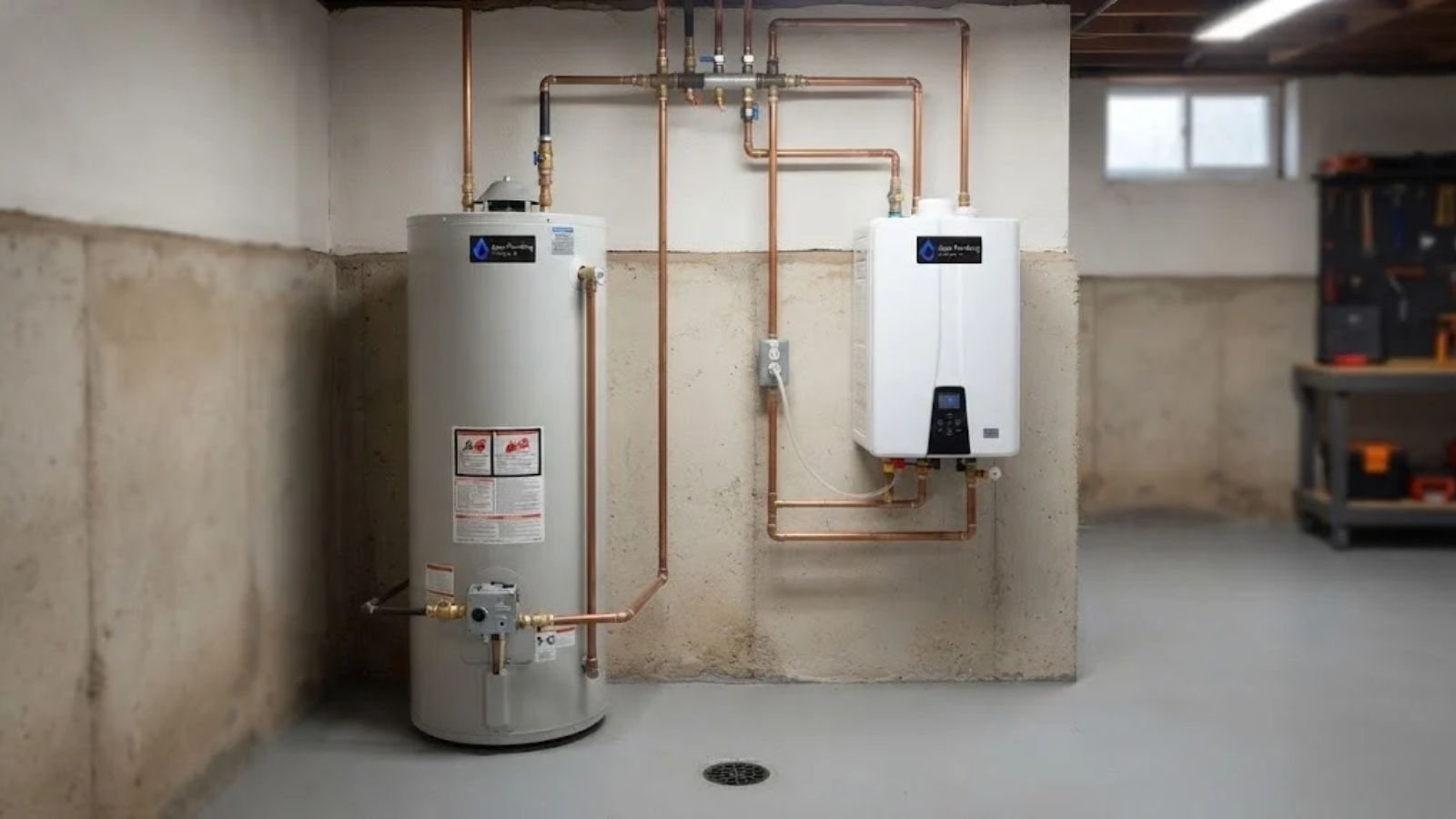
Both tank and tankless water heaters work well in Birmingham. Neither is immune to the hard water supplied by the Birmingham Water Works Board, and both need a maintenance approach suited to that water rather than whatever the manufacturer assumes for an average national customer. The real differences are in cost, space, capacity, and what maintenance actually looks like day to day.
Tankless usually costs more to install
A tank water heater installation or replacement is typically less expensive upfront, especially when replacing an existing tank in the same location with the same fuel type. Converting to tankless often means additional gas line, venting, or electrical work depending on the unit's power needs, which adds real cost to the installation even though the unit itself may run more efficiently over its lifetime.
Different upkeep, not less upkeep
A tank benefits from an annual flush to clear sediment before it hardens against the tank bottom. A tankless unit needs an annual descale of its heat exchanger instead. Manufacturers often specify that descale as a warranty condition in hard-water areas rather than optional maintenance. Skipping tankless water heater service here is one of the more common reasons a tankless unit underperforms its rated output within a few years, right in line with what the manufacturer actually warned against.
| Factor. | Tank. | Tankless. |
|---|---|---|
| Upfront installation cost. | Lower, especially like-for-like. | Higher, often needs added gas/electrical work. |
| Space required. | Closet or utility room footprint. | Compact, wall-mounted. |
| Hot water capacity. | Limited by tank size. | Continuous, limited by flow rate. |
| Required maintenance here. | Annual flush. | Annual descale (often warranty-required). |
| Typical working life. | 8-12 years. | 15-20 years with proper maintenance. |
Households in Hoover spanning both older and newer construction see this choice come up constantly during replacement calls, and the right answer genuinely depends on the household's hot water usage pattern and willingness to keep up with tankless-specific maintenance, not a universal best answer.
A more useful question to ask
A household with fairly predictable, moderate hot water use gets less practical benefit from tankless's main advantage of continuous hot water. That's a family that doesn't often run the dishwasher, washing machine, and two showers at once. A properly sized tank rarely runs out for that usage pattern anyway. A household that regularly hits simultaneous high demand, or that values reclaiming the floor space a tank takes up, sees more real benefit from tankless despite the higher installation cost and stricter maintenance requirement. Neither answer is wrong; they just fit different situations, which is why a technician asks about actual usage patterns before recommending one over the other rather than defaulting to whichever is newer or more expensive.
What to do when a tank fails now
A failed tank rarely leaves time for a leisurely comparison, and replacing like-for-like is almost always the faster, lower-cost path back to hot water. Converting to tankless at that moment adds installation complexity - confirming gas line capacity, venting requirements, or available electrical circuits - on top of the time pressure of having no hot water in the meantime. If tankless is genuinely the better long-term fit for the household, it's usually worth planning that conversion ahead of a failure rather than deciding it under pressure with the household currently without hot water.
Gas vs. electric, for either type
The tank-versus-tankless decision is separate from the gas-versus-electric decision, and it's worth not conflating the two. A gas unit, tank or tankless, typically recovers hot water faster and costs less to operate where natural gas is available, while an electric unit is often simpler and cheaper to install where gas isn't already run to the water heater's location. Switching fuel sources during a replacement, in either direction, adds its own installation requirements on top of whatever tank-versus-tankless decision is also being made, so it's worth discussing both questions together with a technician rather than as two separate projects.
How hard water shapes the real decision
Every comparison above assumes both options get properly maintained, and in Birmingham that maintenance requirement is more demanding than in a soft-water market regardless of which type is chosen. A household that's honest with itself about whether it will actually keep up with an annual tankless descale, rather than assuming it will happen automatically, gets more realistic guidance from that self-assessment than from any spec sheet comparison. A tank forgives a missed flush more gracefully than a tankless unit forgives a missed descale, which is a genuine factor in this decision beyond the usual cost and space considerations most comparisons focus on.
Simple habits that help both types
A few practices help either type run closer to its full rated life in Birmingham's water. Setting the thermostat to a reasonable level, rather than the maximum, reduces the rate of scale formation somewhat since mineral deposition accelerates at higher temperatures. Addressing a small, slow leak immediately rather than letting it continue prevents the kind of prolonged moisture exposure that speeds up tank corrosion from the outside as well as the inside. Keeping the actual install date and service history somewhere easy to find - a note on the unit itself, a photo in a phone - makes every future service call faster. A technician can then confirm age and maintenance history immediately instead of guessing from the unit's current condition alone.
Neither choice is a mistake
Both tank and tankless water heaters serve Birmingham households well when they're sized correctly and maintained on the schedule the water here actually demands. The decision that matters more than tank-versus-tankless is whether the household will realistically keep up with whichever maintenance path it commits to, since a well-maintained tank consistently outlasts a neglected tankless unit, and the reverse is just as true. That's the question worth answering honestly before comparing brochures, warranty terms, or brand marketing claims either way, since none of those substitute for an honest look at the household's own actual water usage habits day to day.
Common questions
Is tankless actually cheaper over time despite the higher upfront cost?
It can be, through lower energy use and a longer working life, but that math depends on actually keeping up with the required annual descale. Skipping maintenance erodes the efficiency advantage that justifies the higher upfront cost.
Can I just swap a tank for tankless in the same spot?
Sometimes, but it depends on existing gas line capacity, venting, and available electrical circuits. A technician confirms what's actually needed before quoting the conversion.
Serving greater Birmingham, AL
Have a plumbing question of your own?
Call and describe what you're seeing - a real technician can usually tell you what's going on before ever stepping through the door.
Call (855) 575-2890