
Trenchless Sewer Repair: Is It Right for Your Birmingham Home?
Digging up a yard to reach a damaged sewer line sounds like the only option. For many Birmingham homes, it isn't anymore.
By the Birmingham Apex Plumbing team.
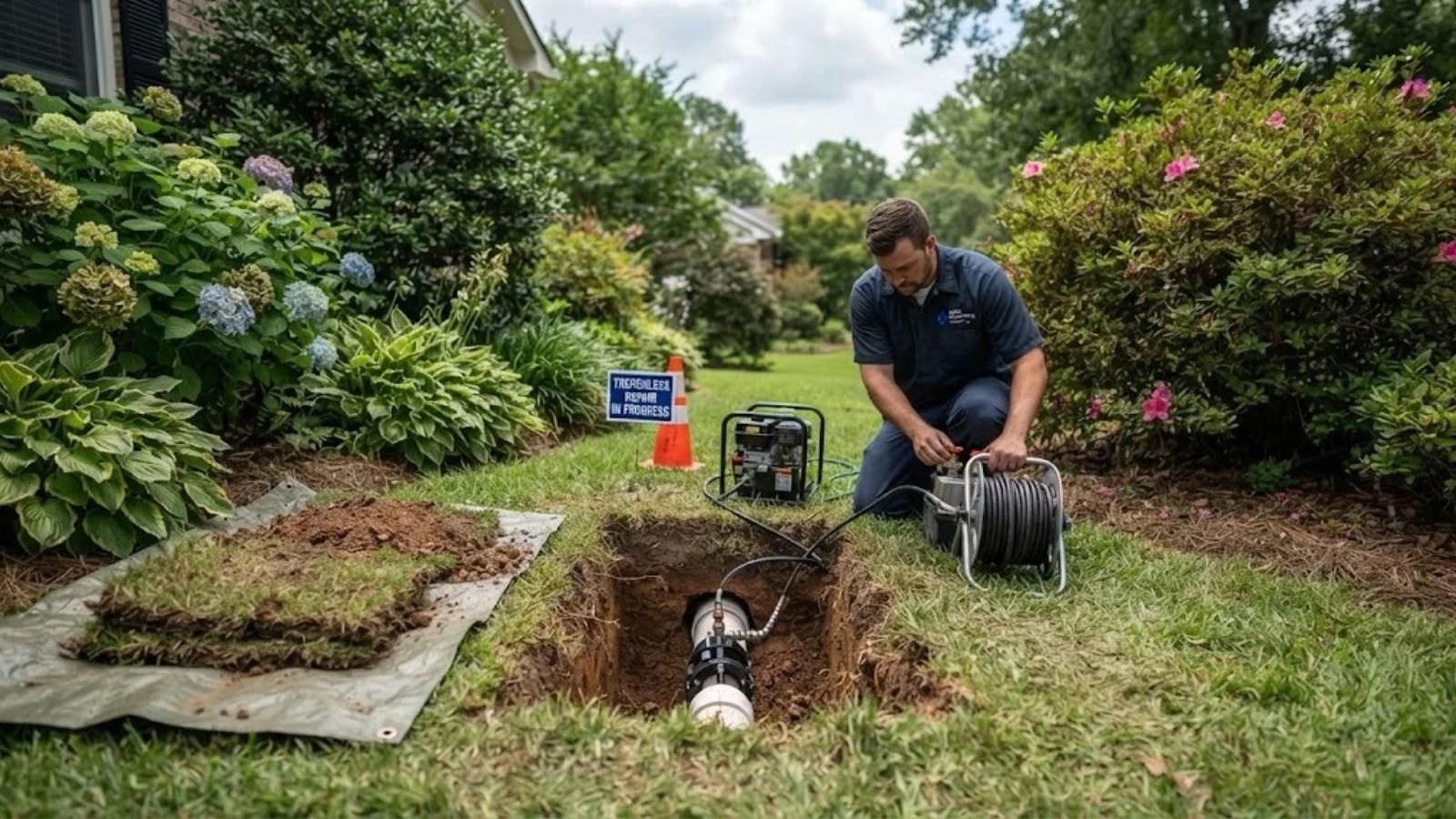
Trenchless pipe lining repairs a damaged sewer line from the inside, without excavating the yard, driveway, or landscaping above it. For a home with mature landscaping, a finished driveway, or a line running under a structure, that difference matters far beyond convenience. It's not the right fit for every situation, though, and knowing which is which before calling saves time during the diagnosis.
A liner cured in place
A flexible liner coated in resin is fed through the existing damaged pipe, then inflated and cured in place, forming a new, smooth pipe wall inside the old one. Access typically requires only one or two small excavation points, rather than trenching the full length of the line. Once cured, the new interior surface resists root intrusion and scale buildup better than the original damaged pipe did, which is part of why it's not just a patch but a genuine long-term repair.
The conditions that make it work
Trenchless lining works well for a line with root intrusion, cracking, or general deterioration, as long as the pipe hasn't collapsed structurally and still holds a reasonably round shape. It's an especially strong fit under mature trees, an established driveway, or hardscaping a homeowner doesn't want disturbed. A camera inspection confirms candidacy before anything else happens, since not every damaged line qualifies.
Honest limitations
A line that's already collapsed, severely offset at a joint, or crushed doesn't have enough structure left for a liner to bond to properly. In those cases, a traditional excavation repair is the more reliable option, even though it costs more in landscape restoration. A good technician says so directly rather than attempting a lining job on a line that isn't a genuine candidate, since a failed lining attempt wastes both time and money without solving the underlying problem.
| Situation. | Trenchless lining. | Traditional dig. |
|---|---|---|
| Root intrusion, cracking, general wear. | Usually a good fit. | Also works, more disruption. |
| Collapsed or severely offset pipe. | Not a candidate. | Usually required. |
| Mature trees or finished landscaping above. | Preserves the surface. | Disturbs the surface. |
| Line under a structure. | Often the only practical option. | Difficult or impractical. |
Weighing it against the alternative
Trenchless lining often costs more upfront per foot of pipe than a traditional dig repair would for the same length, but that comparison misses the full picture. Once landscaping, driveway, or walkway restoration after a traditional dig is factored in, the total cost gap narrows considerably, and for a yard with anything valuable to preserve above the line, lining frequently comes out ahead overall rather than behind.
Why this fits older, established properties
Homes in Vestavia Hills, many built decades ago on mature, well-landscaped lots along the Shades Mountain corridor, are exactly the kind of property where trenchless lining's main advantage matters most. Preserving established trees and hardscaping that took decades to grow in is worth real money on its own, on top of the repair itself.
From diagnosis to a finished repair
The process starts with a camera inspection to confirm the line is actually a candidate, not just assumed to be based on symptoms alone. The line is then cleaned thoroughly, since the liner needs a clean surface to bond to properly. The resin-coated liner goes in, is inflated to press against the pipe walls, and cures in place over a period of hours depending on the resin used. A follow-up camera pass typically confirms the finished repair before the small access points get closed up and restored.
A genuine long-term fix, not a patch
A properly installed trenchless liner is rated for decades of service, comparable to or exceeding the lifespan of the original pipe when it was new. Because the liner is chemically resistant and structurally independent of the old pipe's condition, it doesn't inherit whatever caused the original damage. Root intrusion at old, cracked joints in particular has a much harder time recurring once those joints are sealed inside a continuous new interior surface.
Why the camera comes first, always
A technician who recommends trenchless lining without first confirming candidacy through a camera inspection is skipping a step that genuinely matters. The recommendation should follow the diagnosis, not precede it. A homeowner comparing quotes for sewer repair can reasonably ask whether a camera inspection was actually performed before a specific method was proposed. That answer says a lot about whether the recommendation is based on this particular line's actual condition or just a default sales approach applied to every call.
A specific, evidence-based answer is a reasonable thing to expect before agreeing to any sewer repair, trenchless or otherwise.
When a line needs more than one fix
A longer sewer run sometimes has one section that's a strong lining candidate and another section too damaged for it. That calls for a combined approach rather than forcing the whole line into a single method. Excavating just the collapsed or severely offset portion while lining the rest preserves most of the yard while still addressing the section that genuinely needs traditional repair. A thorough camera inspection identifies these mixed situations upfront, rather than discovering partway through the job that a section doesn't behave as expected.
Being upfront about that possibility before work starts avoids an unpleasant surprise mid-project.
What to expect once the liner is in
A newly lined sewer section needs no special ongoing maintenance beyond what any healthy sewer line needs, which is itself one of the appeal points of the repair. Normal household use resumes immediately once the liner has cured and access points are restored. A follow-up camera inspection years down the line, if ever needed for an unrelated reason, gives a good opportunity to confirm the lined section is still performing as expected. That holds true years after the original work was completed and paid for by the original homeowner who requested it.
Common questions
How long does trenchless pipe lining take?
Often completed within a single day for a typical residential line, though exact timing depends on the length of pipe and number of access points needed.
Does trenchless lining reduce the pipe's interior diameter?
Slightly, since the liner adds a thin new wall inside the old pipe. In practice this rarely affects flow capacity meaningfully for a residential line sized normally.
Is trenchless repair covered by homeowners insurance?
Coverage depends on the cause of damage and specific policy language, similar to any other sewer line repair. Sudden, accidental damage is sometimes covered; gradual deterioration typically isn't.
Serving greater Birmingham, AL
Have a plumbing question of your own?
Call and describe what you're seeing - a real technician can usually tell you what's going on before ever stepping through the door.
Call (855) 575-2890