
What Your Birmingham Home's Pipe Material Actually Tells You
Birmingham's housing spans nearly a century of construction. The pipe material in a specific home says more about what's coming than the home's age alone.
By the Birmingham Apex Plumbing team.
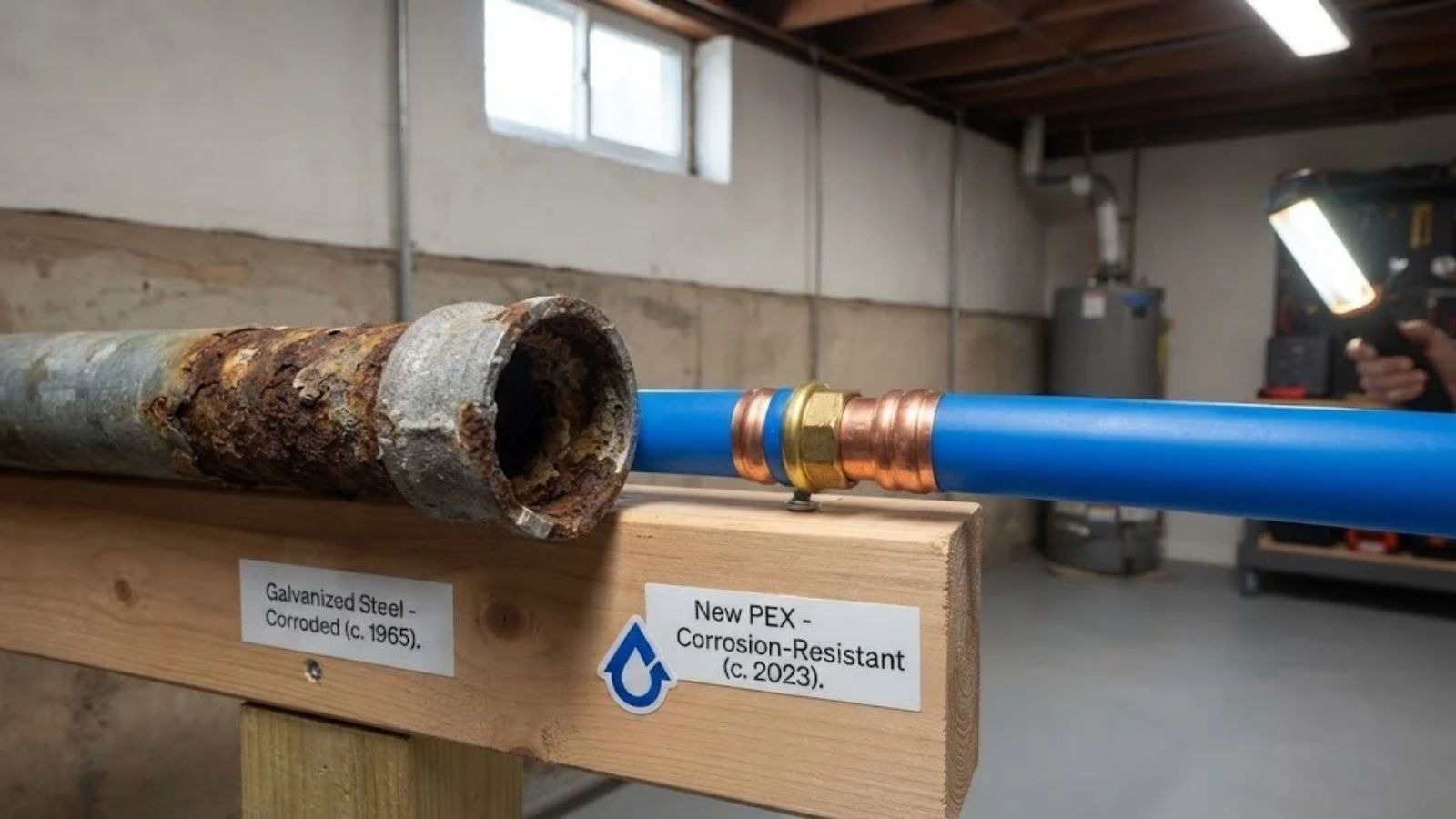
A home's plumbing doesn't fail on a fixed schedule. It fails based on what it's made of, how it was installed, and the water running through it for decades. In neighborhoods like Forest Park and Highland Park, where homes commonly date to before 1960, original galvanized steel supply lines and cast iron drain lines are still doing the job in plenty of houses, just not as well as they used to.
Galvanized steel, copper, and PEX
Galvanized steel corrodes from the inside, narrowing the interior diameter over decades until water pressure drops and rust starts showing up in the water itself - a slow process that's easy to miss until it's fairly advanced. Copper, common in mid-century construction through the 1980s, holds up much better but isn't immune to pinhole leaks after enough years, especially with Birmingham's harder water accelerating the process. PEX, the current standard for new construction and repiping jobs, resists corrosion entirely, which is the main reason it's become the default replacement material rather than a trend.
Cast iron, clay, and PVC
Cast iron drain and sewer lines were the standard for decades and can last a long time. They eventually develop pitting and scale on the interior surface that catches debris and slows drainage well before the pipe actually fails structurally. Clay sewer laterals, common in some of the oldest parts of the city, are particularly vulnerable to root intrusion at their joints. PVC, standard in newer construction, doesn't corrode the same way, though it's not immune to root intrusion where a line runs near mature trees.
A sewer camera inspection is the only real way to know which situation a specific home actually has, rather than guessing from the neighborhood's general age.
| Material. | Common era. | What tends to go wrong. |
|---|---|---|
| Galvanized steel (supply). | Pre-1960. | Interior corrosion, reduced pressure, rust in water. |
| Copper (supply). | 1960s-1980s. | Pinhole leaks after decades of service. |
| PEX (supply). | 2000s-present. | Rare; resists corrosion well. |
| Cast iron (drain/sewer). | Pre-1970. | Interior pitting, scale, eventual cracking. |
| Clay (sewer lateral). | Pre-1960, some areas. | Root intrusion at joints. |
| PVC (drain/sewer). | 1970s-present. | Root intrusion near mature trees, otherwise durable. |
Homeowners in Homewood, where much of the housing stock dates to the city's original 1920s-1950s development, run into this pattern often enough that it's worth knowing before a problem shows up, not after.
What to look for before calling
A few visual checks give a rough sense of what's running through a home's walls without opening anything up. A magnet that sticks firmly to a visible supply pipe usually means galvanized steel; copper and PEX won't hold a magnet. A dull gray, slightly rough pipe with visible pitting or rust staining at joints is a strong sign of galvanized steel nearing the end of its service life. A shiny, reddish-brown pipe is copper. PEX is a flexible plastic tubing, usually red, blue, or white, that's unmistakably different from any metal pipe once you've seen it once. None of this replaces a professional inspection, but it's enough to have an informed conversation on the phone before a technician ever arrives.
Why pipe material matters at closing
Pipe material comes up more often than most buyers expect during a home purchase in Birmingham's older neighborhoods. A standard home inspection typically notes visible pipe material where accessible but doesn't include a sewer camera inspection unless specifically requested. That gap means a buyer can close on a home with a compromised sewer lateral without ever knowing it until the first backup. Requesting a camera inspection as part of due diligence on any home with original plumbing is a small upfront cost that can prevent a much larger surprise a few months into ownership. It also gives real leverage to negotiate a repair credit if the line's condition turns out to be worse than expected.
When a home has more than one material
Plenty of Birmingham homes aren't purely one material or another. A partial repipe done decades ago, an addition built with newer materials than the original structure, or a previous owner's DIY fix can all leave a home with galvanized steel in one section and copper or PEX in another. That mixed situation isn't automatically a problem. It does mean a leak in one section doesn't necessarily predict what's happening elsewhere in the house. A technician typically maps out what's actually present room by room rather than assuming uniformity from a single visible pipe.
Connections between dissimilar metals - old galvanized steel joined directly to newer copper, for instance - are also a specific point of accelerated corrosion called galvanic corrosion, worth flagging if a home's plumbing history includes partial upgrades over the years rather than one clean replacement.
What working life is actually left
Pipe material doesn't fail on a countdown, but rough ranges are still useful for planning rather than reacting. Galvanized steel commonly starts causing real problems 40 to 50 years after installation, though water quality and usage accelerate or slow that considerably. Cast iron drain lines often run 50 years or more before structural failure, even as their interior condition degrades well before that point. Copper typically holds up 50 to 70 years barring a specific pinhole failure. None of these numbers should replace an actual inspection for a home that's already showing symptoms, but they're a reasonable starting point for a homeowner trying to gauge how urgent a proactive conversation about their own home's plumbing actually is.
Water quality changes the math
Those ranges assume typical conditions. Birmingham's harder-than-average water shifts them in a specific direction: faster mineral deposit buildup inside metal pipe, which both narrows the interior diameter and, for galvanized steel specifically, accelerates the corrosion process that eventually causes failure. A home with the same original galvanized supply lines as a similar-aged home in a soft-water city may genuinely be further along in that corrosion process despite identical installation dates, simply because of what's been running through the pipes for decades. That's part of why a technician's in-person assessment matters more than a generic age-based rule, however useful the rule is as a starting point.
Common questions
How do I find out what pipe material my house actually has?
For visible sections (under sinks, in a basement or crawlspace), a plumber can identify the material on sight. For the sewer line specifically, a camera inspection is the reliable way to confirm material and condition.
Does a home need to be fully repiped just because it has old galvanized pipe?
Not necessarily - if the pipe is functioning without repeated leaks or significant pressure loss, it may still have useful life left. Repiping becomes the practical choice once failures start recurring rather than as a preventive step on a fixed timeline.
Serving greater Birmingham, AL
Have a plumbing question of your own?
Call and describe what you're seeing - a real technician can usually tell you what's going on before ever stepping through the door.
Call (855) 575-2890